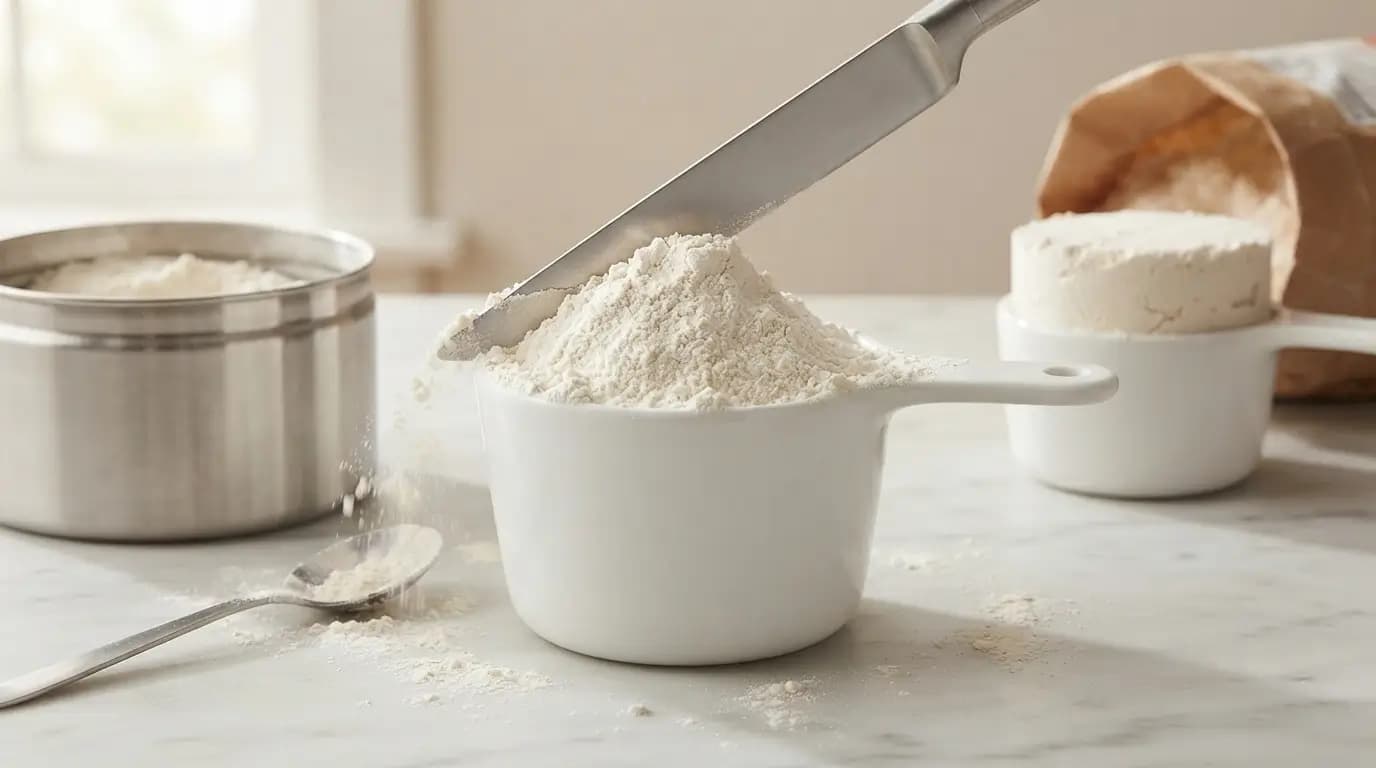
If you've ever followed a recipe exactly and still ended up with a dry, dense cake or a tough loaf of bread, the problem probably wasn't the recipe. It was almost certainly how the flour went into the cup. Of every measuring mistake in home baking, this is the single most common one — and it's also one of the easiest to fix once you know what's actually happening inside that measuring cup.
The Problem in One Sentence
A “cup of flour” isn't a fixed amount — it's a fixed volume, and how densely that volume gets packed is entirely up to you. Scoop a measuring cup straight into a bag of flour, and you compact the flour as the cup pushes through it, dragging in more than a gently filled cup would hold. The difference isn't trivial: scooping directly from the bag instead of spooning and leveling can add up to 25% more flour to a cup than the recipe intended.
Put in weight terms, a cup of all-purpose flour can run anywhere from about 115–120 grams, measured properly, up to 160 grams or more if it's scooped and packed down. That's a swing of nearly 40 grams on a single cup — and most recipes call for two, three, or four cups at once.
What the Spoon-and-Level Method Actually Is
This is the technique King Arthur Baking (one of the most frequently cited authorities on volume measurement in American baking) calls “fluff, sprinkle, and scrape,” and it's the standard nearly every serious baking source — from professional test kitchens to food science writers — converges on when a scale isn't available.
Step by Step
- 1
- 2
- 3Fill until slightly overflowing.Keep spooning until the flour mounds above the rim of the cup.
- 4Level with a straight edge.Run the flat back of a knife (or a bench scraper) across the top of the cup in one clean sweep, letting the excess fall back into the container. What's left should sit exactly level with the rim — not domed above it, not sunken below it.
That's the entire technique. It takes maybe 20 extra seconds compared to scooping, and it's the difference between a cup that holds close to 120 grams and one that holds 140–160 grams of the same flour.
Why Scooping Goes So Wrong
It's worth understanding the mechanism, not just the rule. When a measuring cup is pushed directly into a bag or canister of flour, the cup's edge compresses the flour in front of it as it travels downward, and the flour settles into the cup under that pressure. The deeper and more forceful the scoop, the more compacted the result. Spooning avoids this entirely — the flour falls loosely into the cup under its own weight, with the same air gaps it would have sitting undisturbed, which is exactly the condition most baking recipes are written to expect.
It's Not Just Flour
The same compaction problem applies to cocoa powder, powdered sugar, and any other fine, airy dry ingredient. Brown sugar is the interesting exception — most recipes actually want it packed, specifically because “packed” is baked into how that ingredient's standard measurement is defined (we cover that distinction in our brown sugar guide). The rule isn't “never pack anything” — it's “measure the way the recipe assumes you will,” and for the vast majority of dry ingredients, spoon-and-level is that assumption.
Spoon-and-Level Works for Spoons, Too
The same principle scales down to tablespoons and teaspoons, and it matters more than people expect at that size. A level tablespoon of flour weighs meaningfully less than a heaped one — heaping a spoon can add roughly 50% more than a level measurement, which sounds small until you remember that baking soda, baking powder, and salt are often measured by the teaspoon specifically because a small error there has an outsized effect. Unless a recipe specifically says “heaping” or “rounded,” every spoon measurement in baking should be read as level by default.
Sifted Flour vs. Flour, Sifted — A Wording Trap
Recipe wording hides a genuine distinction here that's easy to miss:
- “1 cup sifted flour” means sift first, then measure.
- “1 cup flour, sifted” means measure first, then sift.
These produce different amounts of actual flour, because sifting itself adds air and reduces density — sifting before measuring gives you less flour per cup than sifting after. It's a small wording difference with a real effect on the result, and worth reading recipes carefully for.
When Spoon-and-Level Still Isn't Enough
Even executed perfectly, spoon-and-level is a controlled estimate, not a guarantee — different flour brands, humidity levels, and how long the flour has been stored can all shift the real number by a few grams either way. That's an acceptable margin for most everyday baking. Where it stops being acceptable is in recipes with very little room for error — delicate pastries, macarons, bread doughs with a specific hydration target — where even a 5–10% flour variance can visibly change the result. In those cases, a digital kitchen scale removes the guesswork completely: 120 grams on a scale is 120 grams every time, regardless of technique, humidity, or how the flour happened to settle in its bag.
Quick Reference
The Bottom Line
Spoon-and-level isn't a fussy extra step — it's the technique most recipes are quietly assuming you're already using, and skipping it is one of the most common reasons a recipe that works for someone else doesn't work the same way in your kitchen. It costs almost no extra time, and it closes most of the gap between measuring by volume and measuring by weight. For anything where that remaining gap still matters, our flour converter and a kitchen scale will get you the rest of the way to a truly repeatable result.
Explore More Baking & Conversion Resources