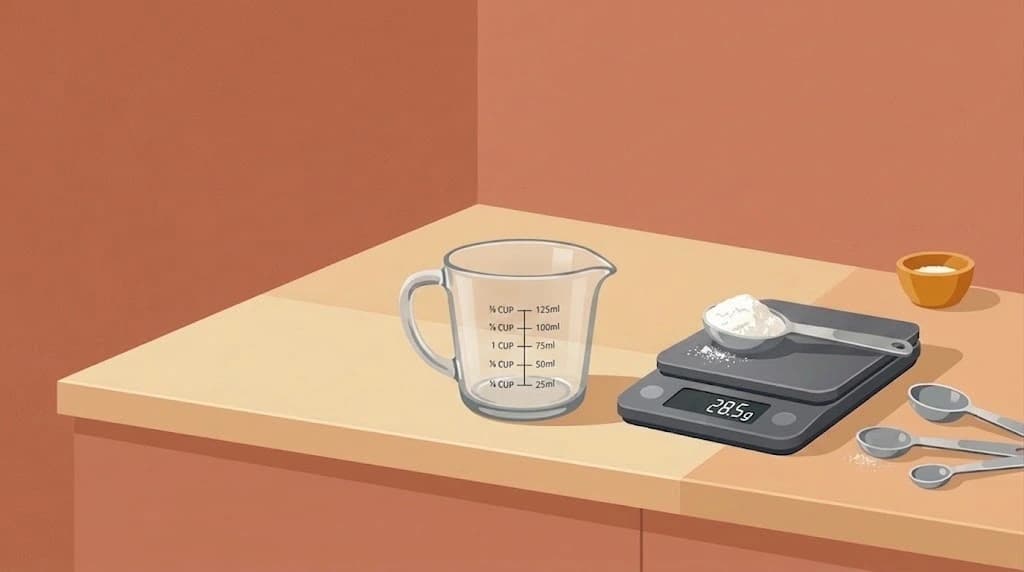
A Cup Measures Space, Not Substance
A US customary cup is approximately 236.6 mL, but not every "cup" used around the world has the same volume. What varies within that space is how much mass fits into it, and that depends on a property called density (grams per milliliter). Two organizations can each publish a well-sourced density figure for the same ingredient and still land on different cup weights, because density itself isn't a single fixed number for most foods — it shifts with moisture, particle size, temperature, and how the material was measured in the first place.
Grams-to-Cups Conversion Formula
For a US customary cup, the underlying math is straightforward:
The formula itself is straightforward. The difficult part is choosing a density value that represents the same ingredient form and measurement conditions as the cup measurement being converted.
How Accurate Are Grams-to-Cups Conversions?
The arithmetic behind a grams-to-cups conversion can be precise, but the practical accuracy depends on the inputs. If the ingredient's density, cup volume, and measurement conditions are known, the conversion can be calculated consistently. The uncertainty usually comes from the density value itself and from how the ingredient behaves when placed in a measuring cup.
For liquids and relatively uniform ingredients, density-based conversions are generally more reproducible. For flour, powdered sugar, oats, nuts, and other particulate foods, packing, particle size, sifting, and ingredient form can cause greater variation.
Accuracy vs. Precision
Accuracy means how close a measurement is to the intended or reference value. Precision means how consistently the same measurement can be repeated. A grams-to-cups conversion can be mathematically precise while still being less accurate in practice if the density value or packing assumption does not match the ingredient being measured.
Two Reference Sources, Compared
USDA FoodData Central is the U.S. government's food and nutrient composition database. It contains several types of food records, and available portion and weight information can vary by data type and source.
FAO/INFOODS Density Database (Version 2.0) , published by the UN Food and Agriculture Organization, compiles food-density information from multiple national and institutional sources. Its records can include different kinds of density measurements, including mass density and bulk density, so individual values should not automatically be treated as interchangeable. This makes the database particularly useful for understanding why reported food densities can vary between sources.
Converting a density figure (g/mL) into grams-per-US-cup means multiplying by 236.6:
| Ingredient | FAO/INFOODS Reported Density Value (g/mL) | Computed Grams per Cup |
|---|---|---|
| Butter | 0.911 | ~216 g |
| Vegetable/cooking oils (various) | 0.88–0.96 | ~208–227 g |
| Olive oil | 0.91–0.92 | ~215–218 g |
| Table salt | 1.217–1.38 (varies by source) | ~288–327 g |
| Baking powder | 0.9 | ~213 g |
| Sodium bicarbonate (crystal) | 2.2 | Not a valid cup figure — see note below |
| Rolled oats | 0.30–0.38 | ~71–90 g |
| White sugar | 0.88–0.95 | ~208–225 g |
| Powdered sugar | 0.56 | ~133 g |
| Almonds | 0.46 | ~109 g |
| Wheat flour (various sources) | 0.48–0.67 | ~114–159 g |
A few of these are worth pausing on.
Where Reported Values Genuinely Diverge
Almonds show one of the widest gaps in this comparison. Common baking references typically put a cup of whole almonds around 140–143 grams. FAO's listed density computes to roughly 109 grams per cup — a difference of over 20%. The FAO entry does not provide enough information in the summary table to establish that its density value represents the same physical form and packing conditions as the whole-almond cup weights reported by kitchen references. Particle arrangement, ingredient form, and measurement conditions can all affect volume-based measurements, so the two figures should not automatically be treated as directly comparable.
Baking soda is a case where a density value and a cup weight can be very different things. FAO lists sodium bicarbonate's density as 2.2 g/mL. A sodium-bicarbonate density value should not automatically be interpreted as the bulk density of baking soda in a household measuring cup. FAO/INFOODS distinguishes mass density from bulk density, and that distinction is particularly important for powders because the air spaces between particles affect how much mass fits into a given volume. Applying a material-density value directly to a household cup can therefore produce a physically inappropriate grams-per-cup estimate — one far higher than the practical cup weights normally used in cooking references.
Table salt spans a real range even within a single database. FAO's own entries for salt range from about 1.217 g/mL to 1.38 g/mL, which computes to roughly 288 to 327 grams per cup. Crystal size and packing can create substantial additional differences between types of salt, particularly when comparing fine table salt with coarse or flaked varieties.
Where the Sources Line Up Closely
It's worth noting where the disagreement is small, because it isn't universal:
- Cooking oils cluster tightly — most common oils fall in a narrow 0.91–0.93 g/mL band, meaning different sources land within a few grams of each other per cup.
- Granulated sugar is similarly consistent — the compiled range (0.88–0.95 g/mL) overlaps comfortably with the ~200 g/cup figure used across most baking references.
- Butter is closer than it might first appear — 0.911 g/mL (≈216 g/cup) versus a commonly cited figure of 227 g/cup is roughly a 5% gap. The difference reflects the fact that these figures may come from different measurement methods, source data, or assumptions about the ingredient and cup measurement. U.S. Dairy also notes that 1 tablespoon of butter is 14 g, which works out to approximately 224 g per 16-tablespoon U.S. cup.
Why the Same Ingredient Gets Different Numbers: Four Real Reasons
Measured vs. derived.
A genuinely kitchen-tested chart may weigh an actual measurement technique — spoon-and-level, packed, or sifted — in a real cup. A density database instead reports mass per milliliter under controlled conditions, and the "cup weight" is calculated afterward by simple multiplication. These are two different processes answering a related but distinct question.
Bulk density vs. true density.
As the baking soda example shows, a powder's material density and its real-world bulk density (with air gaps included) can differ substantially. Any source that doesn't clearly state which one it's reporting is a source to treat cautiously.
Fill technique isn't always disclosed.
Sifted powdered sugar vs. unsifted can differ meaningfully; packed brown sugar vs. loose can differ even more. When a chart doesn't say which technique it assumes, the number is a starting estimate, not a guarantee.
The cup itself isn't universal.
US customary (236.6 mL), US legal (240 mL), metric (250 mL), and other regional cup definitions are all genuinely different volumes. A source using a 250 mL metric cup will report a heavier "cup" for the same ingredient than one using the US customary cup, independent of any density disagreement at all.
For Liquids Specifically
For homogeneous liquids, density-based conversions are generally more reproducible because particle packing is not a factor. However, temperature, concentration, moisture content, and product formulation can still affect density, so "liquid" doesn't automatically mean "fixed number" either — it just means one major source of variation (packing) is off the table.
The Practical Rule
None of this means grams-per-cup charts are unreliable — it means they need to be used consistently rather than mixed. The bigger problem is mixing incompatible measurement assumptions within the same recipe — for example, using a packed flour weight from one source and a loosely measured volume assumption from another. Pick one reasonably authoritative source for a given conversion, note whether it's reporting bulk or true density, and stay consistent within a single recipe rather than chasing the "most accurate" number ingredient by ingredient.
How to Choose a Reliable Grams-to-Cups Conversion
- Prefer a measured kitchen weight when the source clearly explains its method.
- Check which cup standard the source uses.
- For dry ingredients, check whether the value assumes spoon-and-level, scooping, packing, or sifting.
- For density-based conversions, confirm whether the value represents bulk density or material/mass density.
- Make sure the ingredient form matches the density data — for example, whole, chopped, sifted, or ground.
- Don't mix incompatible assumptions from different sources within the same recipe.
The Bottom Line
There is no single grams-to-cups accuracy figure that applies to every ingredient. The conversion formula is straightforward, but its practical accuracy depends on the ingredient's density, physical form, measurement method, and cup definition. When different reputable sources give different grams-per-cup values, the right question is not simply "Which number is correct?" but "What was measured, how was it measured, and under which assumptions?"
Related
- Grams To Cups Converter — convert any ingredient and any amount instantly.
- 100 grams to cups — the quick-reference chart this page's examples are drawn from.
Explore Ingredient Converters
Each of these ingredients has its own full conversion guide, with charts for every common amount — not just 100 grams: